The Affordability of Cats & Corn: A Cast Study of Two Recent Musical Endeavors
CATS:The Jellicle Ball was nominated for nine Tony awards and won three including Best Direction of a Musical Zhalion Levingston and Bill Rauch), Best Choreography (Omari Wiles and Arturo Lyons), and Best Costume Design of a Musical (Qween Jean).
By Scott Burke for MAR Productions
Cats: The Jellicle Ball recently made headlines for announcing its early closure after a mere 22 week run. For comparison: the original Broadway production of Cats ran for 939 weeks. The show’s closing has reignited concerns about the economic viability and, ultimately, the survival of the Broadway musical. The Hollywood reporter asked “Is It Curtains for Broadway Musicals?” and Andrew Lloyd Webber delivered a passionate warning that Broadway theaters risk rivaling Hollywood’s empty soundstages.
In a world where only about 10% of Broadway shows recoup their initial investments, down from the pre-pandemic number of 1 in 5, are Broadway musicals a dying breed? Or do producers just need to be savvy about structuring their shows not only for artistic success, but also financial recoupment?
Let’s begin with a comparison to Shucked, a musical that is similar to The Jellicle Ball and was also lead-produced by Mike Bosner. Taking a look at the numbers, Shucked took roughly $16,000,000 to arrive at opening night while Cats required a similar $18,000,000 (a modest number compared to some of its Broadway siblings – The Great Gatsby opened after a $25,000,000 investment and Moulin Rouge took $28,000,000 to get to opening night). The shows also performed similarly at the Tony awards, each receiving 9 Tony nominations. Shucked took home only one award (for Best Featured Actor) while Cats took home awards for choreography, direction, and costume design. The shows opened during April 2024 and April 2026, respectively, and both had large casts (Shucked at 19 and Cats at a whopping 30). Yet, Shucked ran for over twice as many performances: 355 compared to the 163 of the Jellicle Ball.
Since the shows are so similar, and even shared a lead producer, what caused one to close prematurely and the other to run for 9 months?
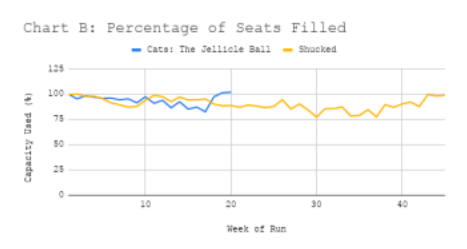
The answer could include anything from changing audience tastes, broad economic factors, or even competition from other shows. What we cannot ignore, however, is operating costs. Of its 22 week run, Cats filled over 90% of seats for 18 of them. The closing announcement came after the show’s weakest week of sales, when it filled only slightly less than 83% of the Broadhurst Theater’s 1,218 seats. The average ticket price remained over $100 for all but two weeks of its run.
In spite of its impressive ticket sales, Cats: The Jellicle Ball failed to even meet operating costs during most of its run, ultimately resulting in its premature closure.
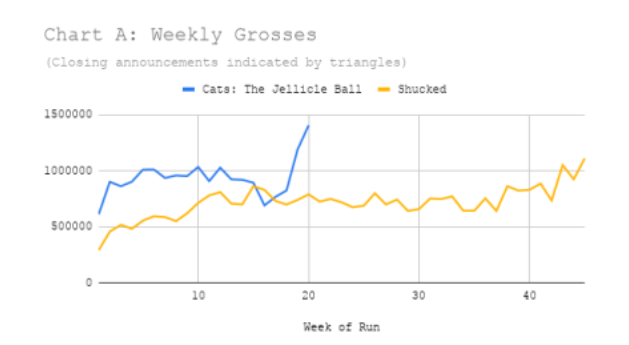
With a large cast of 30 and elaborate staging and design, weekly operating costs ran close to $1,000,000 (see this article from Playbill). Although the raw grosses outperformed Shucked in general, the production’s grosses equaled operating costs for less than a third of its run (see Chart A).
That is not to say Cats was not as artistically successful as Shucked was. The Jellicle Ball, like Shucked, was nominated for 9 Tony Awards. It won three: for choreography, direction, and costume design. Not to mention the show brought the vibrant world of ballroom culture to the Broadway stage and featured the first openly trans person to win a Tony.
But money doesn’t appear out of nowhere. A show on Broadway owes its investors an attempt to recoup initial investment, not go further into debt. For Shucked, that was possible. Cats had mostly-full houses and filled comparable seats to Shucked (see Chart B) for most of its run. After the announcement of the show’s closing and public support
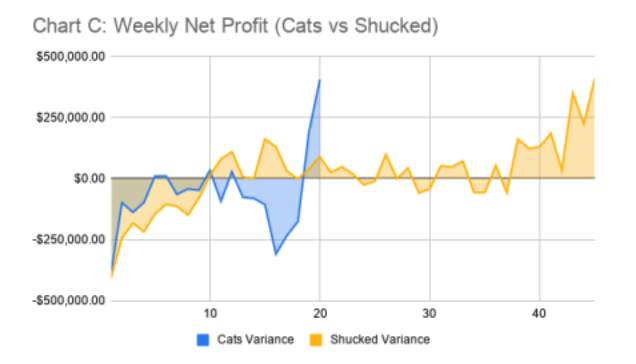
from Andrew Lloyd Webber, the show sold out most of its remaining performances for an exceptional final few weeks of performance. Yet, the smaller cast size and more moderate production values of Shucked allowed the show to operate at nearly $300,000 less a week than The Jellicle Ball (See this Q&A with Mike Bosner). With small (if any) profit margins for Broadway shows, that difference of a few hundreds of thousands of dollars can make the difference between breaking even and operating at a consistent financial deficit. Cats closed incredibly early because it was unable to even make back its basic operating costs (see Chart C).
When Shucked finally did close, it was only once its weekly grosses stopped consistently paying for its operating costs. The show then found more ways to make money in its afterlife through a cast album, its 2025 revival in London’s Regents Park, and being licensed through MTI. The show recently announced its plans for a second 2027 national tour.
But what other options did Bosner and the producers of Cats have? Somehow cut operating costs? Increase ticket prices? After the initial cost of investment, many costs are standardized and set in stone by contracts between unions and the show, and by the owners of the theaters themselves. Productions also must often pay rent to the theater-owner, as well as fees to ticket vendors and deal with relentlessly rising costs of production in general.
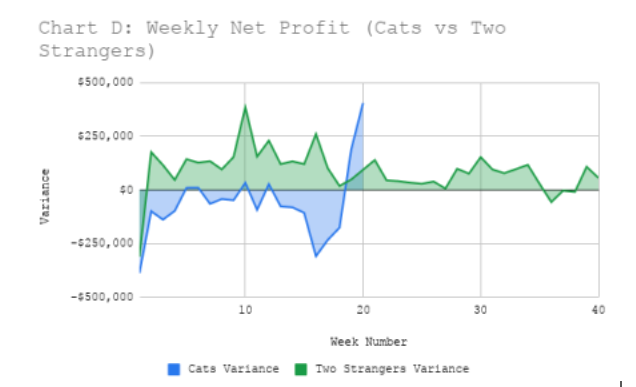
One recent production, however, has succeeded in making a profitable musical despite the harsh financial conditions of Broadway today. Two Strangers Carry a Cake Across New York is a rare two-hander: a show that has only two actors. The show only needs a small band to adequately render its music. As such, their weekly operating costs sit very low for a modern Broadway musical at around $500,000.
Though Two Strangers has only ever once grossed more than Cats in a given week, the show has already run for nearly twice as long. In fact, Two Strangers was Broadway’s lowest-grossing show of the week ending August 2nd but has yet to announce closing. Due to its lower operating costs, Two Strangers has been able to consistently operate in the green (see Chart D) since its opening.
The current financial situation on Broadway incentivises safe productions: ones that are simple and easy to operate (like Two Strangers) or ones that are supported by existing intellectual property (think: The Outsiders or The Cursed Child). It is easier to break even when operating costs are lower or when existing IP means a show has to do less legwork to achieve name recognition and fill seats.
Unless the financial situation changes significantly on Broadway, we are likely to see more lean productions like Two Strangers and shows backed by existing IP like The
Cursed Child. Here at MAR productions, we are following this trend in the industry. Our musical-in-development, Chimney Town, hopes to cash in on the name-recognition of the beloved Japanese Children’s book and its following in Asia. Our other new production, Spells of the Sea, is exploring development opportunities in the UK to find new, more affordable paths to the Great Colorful Way.
In the meantime, while we mourn the early closure of The Jellicle Ball, we continue to stay on top of Broadway trends and can continue to look for new ways to make our productions both successful and affordable in a challenging time for the industry.